


Designing an exam room is like solving a puzzle. If your equipment doesn’t fit the space, your workflow will suffer every day. We help you choose the right refraction unit to maximize your clinic’s efficiency.
An ophthalmic refraction unit is the workstation that integrates a patient chair with instrument arms for a phoropter, slit lamp, and vision chart projector. To choose the right one, you must balance your room’s dimensions with the number of instruments you need and your desired patient comfort level.
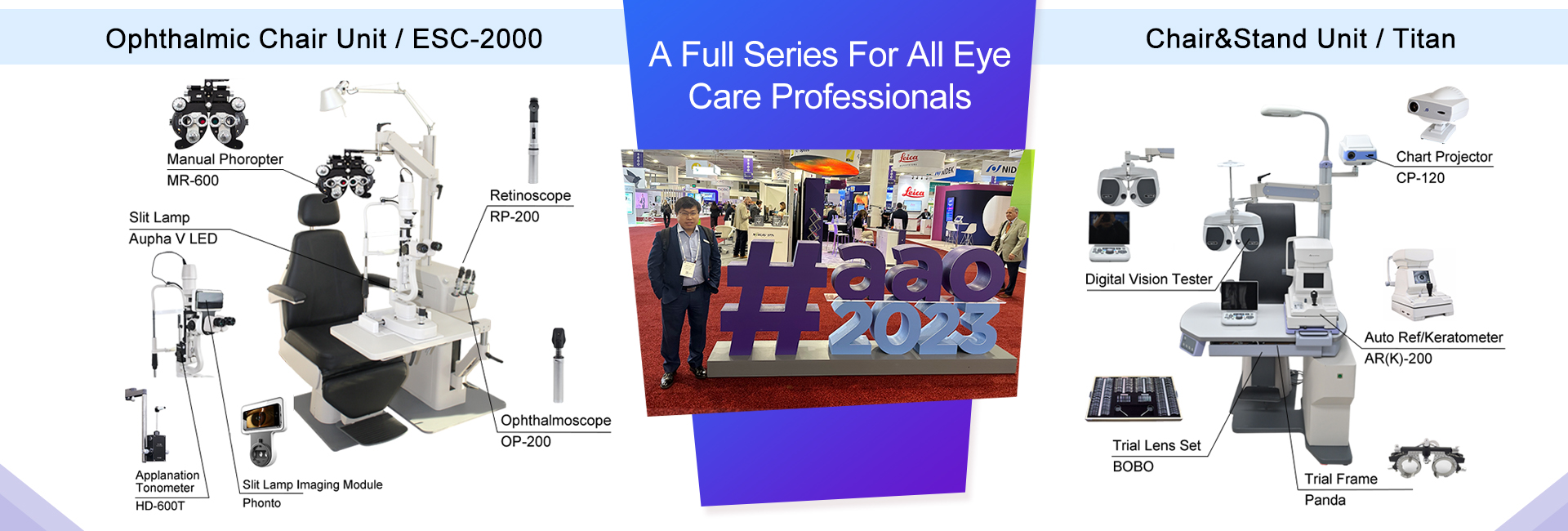
At Hongdee, we offer 7 different types of refraction units, from the compact HD-120 to the heavy-duty Hulk and Titan series. We understand that every exam lane has unique requirements.
What Is an Ophthalmic Refraction Unit and What Equipment Does It Actually Hold?
Many people call it a “chair and stand,” but it is much more than that. It is the command center for your entire vision exam. We break down the components that make up a professional refraction unit.
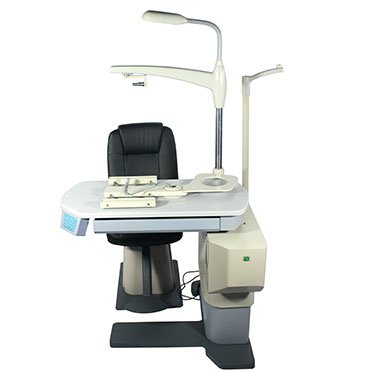
A standard ophthalmic refraction unit consists of a motorized patient chair, a vertical stand, and one or more instrument arms. It typically holds a manual or digital phoropter, a chart projector or LCD vision chart, and often includes a sliding table for a slit lamp or auto refractometer.
The Central Stand and Lighting
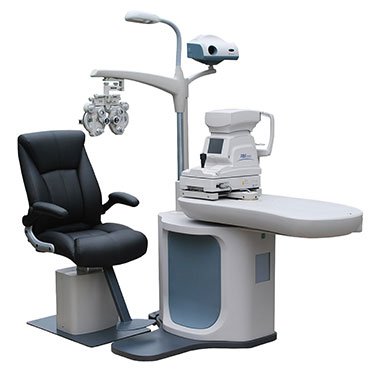
The vertical stand is the backbone of the unit. It supports the weight of your most expensive instruments. Most professional units, like our HD-700C, include an overhead lamp and a charger for handheld tools like retinoscopes and ophthalmoscopes. This keeps your room organized and ensures your handheld equipment is always ready for use. By centralizing the power supply, you also reduce the number of messy cables running across your floor.
Instrument Support Arms
The arms are the most functional part of the stand. A balanced phoropter arm allows you to swing the instrument in front of the patient’s eyes with a single finger. A good arm should be “drift-free,” meaning it stays exactly where you put it. Lower arms often feature a sliding or rotating table. This allows you to perform a slit lamp exam and then quickly move the machine out of the way for the refraction part of the test.
Integrated Control Panels
Modern units feature a centralized control panel, usually located on the side of the stand or the tabletop. From here, you can raise or lower the patient chair, dim the room lights, and control the chart projector. This allows you to perform the entire exam without ever leaving your seat. At Hongdee, we focus on making these controls intuitive so you can stay focused on the patient’s eyes.
| Component | Standard Function | Why It Matters |
|---|---|---|
| Motorized Chair | Positions the patient | Comfort and height alignment |
| Phoropter Arm | Holds vision testing tool | Precise positioning for refraction |
| Sliding Table | Holds slit lamp/refractometer | Multiple tests in one seat |
| Overhead Lamp | Provides ambient light | Essential for physical exams |
Single, Dual, or Triple Instrument Arm Configurations: Which Seating Capacity Fits You?
The number of “arms” determines how many instruments you can use without moving the patient. Your choice depends on your clinical specialty and how fast you want your exams to go. We explain the three main configurations.
Single-arm units are compact and affordable, perfect for basic vision screenings. Dual-arm units are the industry standard, holding both a phoropter and a slit lamp. Triple-arm units, like our Hulk series, offer maximum flexibility for advanced diagnostic equipment, reducing patient movement to an absolute minimum.
The Compact Single-Arm Setup
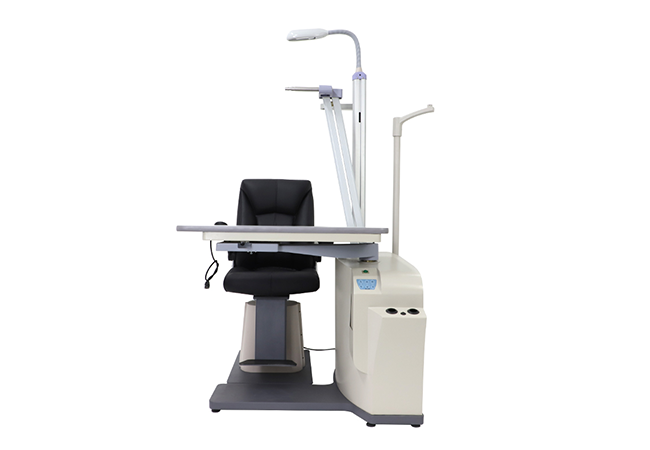
If you have a very small room or a limited budget, a single-arm unit like the HD-120 is a smart choice. It typically holds only a phoropter. You will need a separate table for your slit lamp. While this requires the patient to move between two different chairs, it allows you to fit a functional exam lane into a very tight space. This is a popular choice for startup optical shops in busy city centers.
The Standard Dual-Arm Unit
Most private practices choose a dual-arm configuration like our HD-450S. One arm holds the phoropter, and a sliding table below it holds the slit lamp. This is the most efficient setup for a general eye exam. The patient sits down once, and you can perform both the eye health check and the vision correction without them ever standing up. This significantly reduces the time spent per patient and increases your clinic’s daily capacity.
The Powerful Triple-Arm Configuration
For high-end specialty clinics, we recommend a triple-arm unit like the Titan or Hulk. These units are built to handle heavy loads. In addition to a phoropter and slit lamp, you can mount a third instrument like a fundus camera or a digital imaging system. While these units take up more floor space, they offer the most professional “high-tech” look and the fastest workflow for complex diagnostic cases.
| Configuration | Best For | Typical Equipment |
|---|---|---|
| Single Arm | Small Rooms / Startups | Phoropter only |
| Dual Arm | General Optometry | Phoropter + Slit Lamp |
| Triple Arm | Specialist / High Volume | Phoropter + Slit Lamp + Imaging |
| Sliding Table | Multi-Diagnostic | Slit Lamp + Auto Refractometer |
How Do You Measure Your Exam Room for Dimensions, Door Placement, and Workflow?
Buying a unit that doesn’t fit your room is a disaster. You need to consider more than just the floor space of the machine. We share our professional space planning tips to ensure your new unit fits perfectly from day one.
Measure your exam room’s total floor area and carefully note the location of doors, windows, and power outlets. A standard refraction unit requires a footprint of approximately 4ft by 5ft (1.2m x 1.5m), but you must also leave at least 3 feet of clearance for the patient to enter and for the chair to recline fully.
Mapping the Patient Path
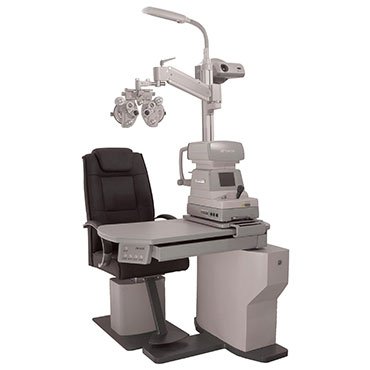
The “flow” of your room is vital. When a patient enters, they should be able to walk directly to the chair without bumping into the equipment arms. Look at which way your door swings. If the door hits the unit when it opens, you will damage both. We always recommend placing the unit against the wall opposite the door. If your room is very narrow, consider a “linear” unit where everything is aligned along one wall rather than an L-shaped corner unit.
Considering Recline and Rotation
Most motorized chairs can recline and rotate. This is essential for certain surgical procedures or for patients with mobility issues. When you measure your space, you must account for the “extended” length of the chair. If you put the chair too close to the back wall, you won’t be able to recline it. At Hongdee, we provide detailed technical drawings for all our models, like the HD-3200, so you can plan your room before the equipment arrives.
The Power and Lighting Layout
Don’t forget the electrical requirements. A refraction unit needs at least one grounded outlet. Ideally, this outlet should be located behind the stand to hide the cables. If you are using a mirrored vision chart (to save space), you also need to plan where the mirror will be mounted on the opposite wall. We help our 60+ distributors worldwide with room layouts to ensure every customer gets a functional and beautiful exam lane.
| Room Dimension | Minimum Requirement | Pro Tip |
|---|---|---|
| Total Length | 10 ft (3 meters) | Use a mirror for 20ft vision tests |
| Total Width | 8 ft (2.4 meters) | Keep equipment arms away from paths |
| Ceiling Height | 8 ft (2.4 meters) | Ensure overhead lamp has clearance |
| Power Outlets | 2-3 Grounded | Install behind the unit stand |
What Patient Chair Ergonomics Should You Look for: Recline, Armrests, and Headrest?
The chair is the only part of the equipment that the patient actually touches. If it is uncomfortable, they will have a negative impression of your practice. We explain the ergonomic features that make a chair professional and comfortable for everyone.
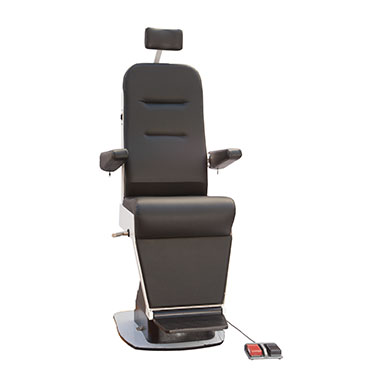
Look for a patient chair with smooth motorized lift, adjustable armrests, and a sturdy headrest for stability during examinations. Professional chairs, like those in our HD-700 series, offer a full recline feature and a 90-degree rotation, making them suitable for both general exams and minor surgical procedures.
The Importance of Smooth Lift
Cheap chairs often have a “jerky” start and stop. This can be scary for elderly patients or children. We use high-quality European or Japanese-style motors that provide a slow, steady lift. The chair should be able to handle at least 150kg without straining. When the patient feels stable and secure, they are more likely to stay still during the refraction, which leads to a more accurate prescription for you.
Armrests and Accessibility
Armrests are often overlooked, but they are critical for patient comfort. We design our units with “flip-up” armrests. This allows patients in wheelchairs or those with limited mobility to slide into the chair more easily. It also makes the room feel more open. A good chair should also have a footrest that moves in sync with the chair’s height, ensuring the patient’s legs are always supported.
Headrest Stability and Rotation
During a slit lamp exam, the patient’s head must be perfectly still. A stable, adjustable headrest is a must. It should be easy to clean between patients to maintain high hygiene standards. Rotation is another key feature. If the chair can rotate 90 degrees, you can easily move the patient away from the equipment for a physical eye exam or to administer eye drops. This flexibility is what separates a professional medical chair from a basic optical one.
| Ergonomic Feature | Benefit to Patient | Benefit to Doctor |
|---|---|---|
| Motorized Recline | Comfort during long tests | Better access for minor procedures |
| Flip-up Armrests | Easier entry/exit | Accommodates more patient types |
| Rotating Base | Less claustrophobic | Better workflow flexibility |
| Sync-Footrest | Leg support | Reduces patient fidgeting |
Why Does Brand Compatibility Matter When Matching Chair and Stand?
You might be tempted to buy a chair from one brand and a stand from another to save money. We explain why this “mix and match” approach can lead to long-term headaches and hidden costs for your clinic.
Brand compatibility ensures that the chair’s electronics integrate seamlessly with the stand’s control panel, allowing you to operate everything from a single interface. Matching components from one manufacturer like Hongdee guarantees perfect fitment, synchronized movement, and simplified technical support for your entire refraction lane.
Electrical Integration
A unified refraction unit uses a single power cable. The stand provides power to the chair, the lamp, and all the instruments. If you mix brands, you often end up with three or four different power cords and multiple remote controls. This is not just ugly; it is a tripping hazard. When you buy a complete Hongdee unit, we ensure that the chair’s “up/down” buttons on the stand work perfectly with the motor in the chair.
Mechanical Fit and Balance
Instrument arms are designed to handle specific weights. If you mount a very heavy phoropter onto a stand that wasn’t designed for it, the arm might sag or even break. By sticking to one brand, you know that the “Titan” stand is built to handle the “Titan” chair and all the associated tools. This structural integrity is vital for the safety of your patients and the longevity of your expensive diagnostic instruments.
The Value of One Point of Contact
As an OEM for Topcon for 3 years, we know the importance of standardized quality. If a part breaks, you only have to call one supplier. You don’t have two different companies blaming each other for a compatibility issue. We keep spare parts for all our 7 unit types in stock, ensuring that our 300+ customers worldwide can get back to work quickly if a problem occurs. This consistency is the greatest value we offer.
| Factor | Unified Brand Unit | Mixed Brand Setup |
|---|---|---|
| Control System | Single Integrated Panel | Multiple Remotes/Switches |
| Aesthetics | Matching Colors & Styles | Clashing Designs |
| Power Supply | Single Plug System | Multiple Power Cords |
| Support | One Service Provider | Multiple Companies to Call |
Conclusion
Choosing the right refraction unit is an investment in your daily comfort and your patient’s experience. By considering your space and choosing a compatible, integrated system, you create a professional environment that will serve your practice for many years.