


Choosing equipment for a wheelchair user is a whole-workflow question, not a promise that one table or instrument fits every chair.
Choose a coordinated setup by observing transfer and positioning needs, verifying the actual chair-user-equipment relationship, checking controls and safety, and documenting what requires local clinical or facilities approval.
At Hongdee, we recommend evaluating the complete combination of instrument, table or stand, chair, operator position, cables, and room route. We do not claim that every wheelchair, patient, or Hongdee product is automatically compatible. Qualified clinical and facilities professionals must determine whether a proposed setup is safe for the intended person and site.
What patient and workflow needs should guide the shortlist?
First, define what the patient must do during the examination and whether the workflow assumes an unsuitable transfer. A product category alone cannot answer this.
Describe the examination sequence, patient position, transfer policy, assistance needs, operator access, and emergency considerations before comparing equipment features or requesting a quotation.
Start with the real encounter
Ask the qualified clinical team to map the encounter from arrival to departure. Does the patient remain in the wheelchair throughout, transfer with assistance, or use different seating for different steps? Which parts require the patient to maintain a head or torso position? Where does the operator stand or sit? What happens if the patient cannot reach a control, keep still, or tolerate a position? These questions define requirements more reliably than labels such as “accessible.”
We recommend documenting the range of chairs and patient needs the clinic actually expects, without turning that description into a universal compatibility claim. A powered chair, manual chair, tilt-in-space chair, or specialized seating system can differ in geometry and stability. A patient’s clinical condition can also change the safe workflow. Procurement should therefore ask for evaluation criteria, not assume that a single product image settles the issue.
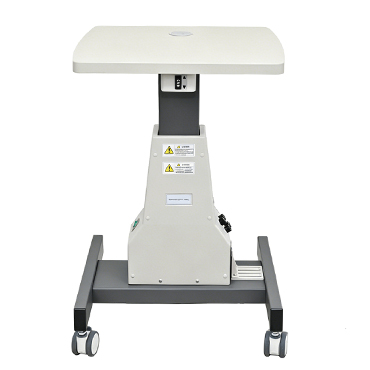
The Hongdee ophthalmic motorized table page can help identify a table category for discussion. It does not establish that every wheelchair can approach, fit, or remain safely positioned at the table. Request configuration-specific information and involve the responsible professional.
| Requirement to define | Why it affects selection | Who should confirm |
|---|---|---|
| Remain seated or transfer | Changes equipment and procedure assumptions | Clinical lead and patient-care team |
| Chair type and accessories | Affects approach and positioning | Facilities or accessibility reviewer |
| Operator access | Determines controls and observation path | Qualified clinical user |
| Assistance and emergency plan | Sets safe staffing boundaries | Clinical and safety leads |
| Range of intended users | Prevents overbroad compatibility claims | Procurement with reviewers |
Observe without pressuring the patient
A trial should be planned with the clinic’s consent and safety process. Do not ask a patient to attempt a transfer merely to validate a purchase. If a patient-specific assessment is needed, qualified staff should lead it. Procurement can record the decision criteria and unresolved questions while avoiding treatment advice.
How do you validate the physical relationship between wheelchair, patient, and equipment?
The second decision is whether the actual combination can be positioned and operated safely. This requires more than reading a product description or looking at a nominal table range.
Conduct a supervised, site-specific fit review using the intended chair and workflow, recording observations and constraints without asserting unverified dimensions or regulatory compliance.
Test the relationship, not an isolated device
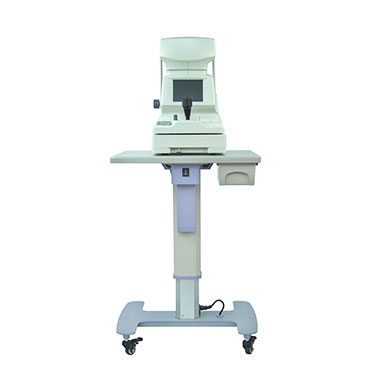
The review should consider approach path, turning space, chair stability, patient support, instrument reach, operator posture, and the position of any foot controls or accessories. The relevant unit is the complete setup. A table may move, but that does not by itself prove that a particular wheelchair can approach it safely or that the patient can be positioned for every intended examination.
We deliberately avoid publishing a universal dimensional threshold or claiming ADA compliance for a product. Requirements can depend on country, facility policy, chair type, local building conditions, and the specific clinical workflow. The National Council on Disability Eames Report is a historical source describing barriers in equipment and design; it should not be treated as current law or as evidence that a particular product meets today’s requirements.
Use a structured observation sheet: chair and support description, approach direction, transfer assumption, operator position, control reach, cable route, patient support, sightline, and any blocked movement. Mark items as observed, supplier-confirmed, locally reviewed, or not assessed. If a fit question depends on a dimension, ask the appropriate supplier or facilities professional to confirm it for the exact configuration rather than estimating from a photograph.
Check dynamic conditions carefully
Movement can change risk. Consider what happens while a table, chair, or instrument is adjusted, including the patient’s hands, feet, mobility aids, tubing, cables, and accessories. Only trained, authorized personnel should operate powered movement during a review. Keep bystanders clear and follow the manufacturer’s instructions. Do not defeat interlocks, bypass controls, or place hands in moving mechanisms.
If the setup cannot meet a required workflow without improvisation, classify it as unresolved. A workaround may expose the patient or operator to risk and should not be normalized as “close enough.”
Which controls, support features, and safety boundaries matter?
A setup can fit physically but still fail the practical test if the operator cannot control it, the patient lacks support, or staff must improvise during a change in position.
Compare controls, patient support, operator access, movement limits, accessory interfaces, and emergency procedures against the clinic’s defined workflow, with each safety question assigned to an authorized reviewer.
Review controls and handoffs
Identify who controls examination positioning, who supports the patient, and who can stop movement. Controls should be reachable by the authorized operator without requiring an unsafe posture or an unplanned handoff. If a patient-operated control is contemplated, qualified staff should decide whether that is appropriate; do not assume that a control’s location makes it suitable for every patient.
Check how the team will communicate before movement and what happens if the patient signals discomfort or the equipment behaves unexpectedly. The review should include an accessible stop or escalation method as described by the manufacturer and clinic policy. This is not a request to modify wiring or mechanisms. If the supplied control arrangement is not adequate, ask the supplier and qualified technical staff for an approved solution.
Patient support deserves the same attention as instrument alignment. A wheelchair cushion, head support, arm support, or positioning aid may affect the examination, but procurement should not prescribe clinical positioning. Record the clinical team’s requirement and have the responsible professional approve the method.
Include maintenance and cleaning realities
The chosen setup should have a clear method for routine care that staff can perform safely. Ask where cleaning instructions apply and which surfaces or accessories require special handling. Do not infer infection-control suitability from appearance. If a powered table or instrument needs technical service, identify the authorized route and keep staff away from internal repairs.
The Hongdee service page is a contact route for discussing support scope. It is not a promise that a specific accessibility adaptation, onsite service, or local compliance review is included. Put confirmed responsibilities in the quotation or implementation record.
How should you make and document the final equipment decision?
The final decision is whether the proposed setup supports the intended wheelchair-user workflow without unverified assumptions. A general accessibility label is not enough for a safe procurement record.
Approve a configuration only when the clinical workflow, physical fit review, controls, site responsibilities, and escalation plan have documented owners; otherwise narrow the use case or pause the order.
Use a requirement-to-evidence matrix
Create rows for the requirements defined by the clinic and columns for evidence, owner, status, and decision. Evidence may be an observed site review, an exact supplier confirmation, a local facilities assessment, or a clinical approval. Do not mark a row complete because a product page uses a broad accessibility phrase.
| Decision area | Acceptable evidence | Pause condition |
|---|---|---|
| Intended workflow | Clinical team’s documented sequence | Transfer or seated use is unclear |
| Chair-equipment fit | Review with intended setup | Only a stock image or assumption exists |
| Operator controls | Authorized user confirms access | Unsafe handoff is required |
| Movement and support | Manufacturer instructions and local review | Pinch, stability, or support risk is open |
| Site responsibility | Named facilities and clinical owners | No one owns the final check |
Keep the matrix with the quotation and repeat it if the chair, table, instrument, or room changes. The Hongdee quote contact page can support a configuration discussion, but the clinic remains responsible for its patient-care approval and local review.
Respect individual variation
A setup that works for one wheelchair user may not work for another. Procurement language should therefore say what was evaluated and what was not. If the clinic needs a broader range, expand testing criteria rather than overclaiming universal fit. When the equipment cannot support a required workflow, refer the decision to the qualified clinical and facilities team instead of asking staff or patients to accept an unsafe workaround.
Sources and scope
- World Health Organization, “Procurement resource guide” (accessed 2026-10-12; foundational procurement-planning context, not a current accessibility regulation).
- National Council on Disability, “Eames Report” (accessed 2026-10-12; historical equipment-accessibility barrier context, not current law or product compliance evidence).
Conclusion
Choose the complete wheelchair-user workflow, validate the actual setup with qualified reviewers, and document limits honestly. No product image or broad label can replace patient-specific and site-specific safety review.