


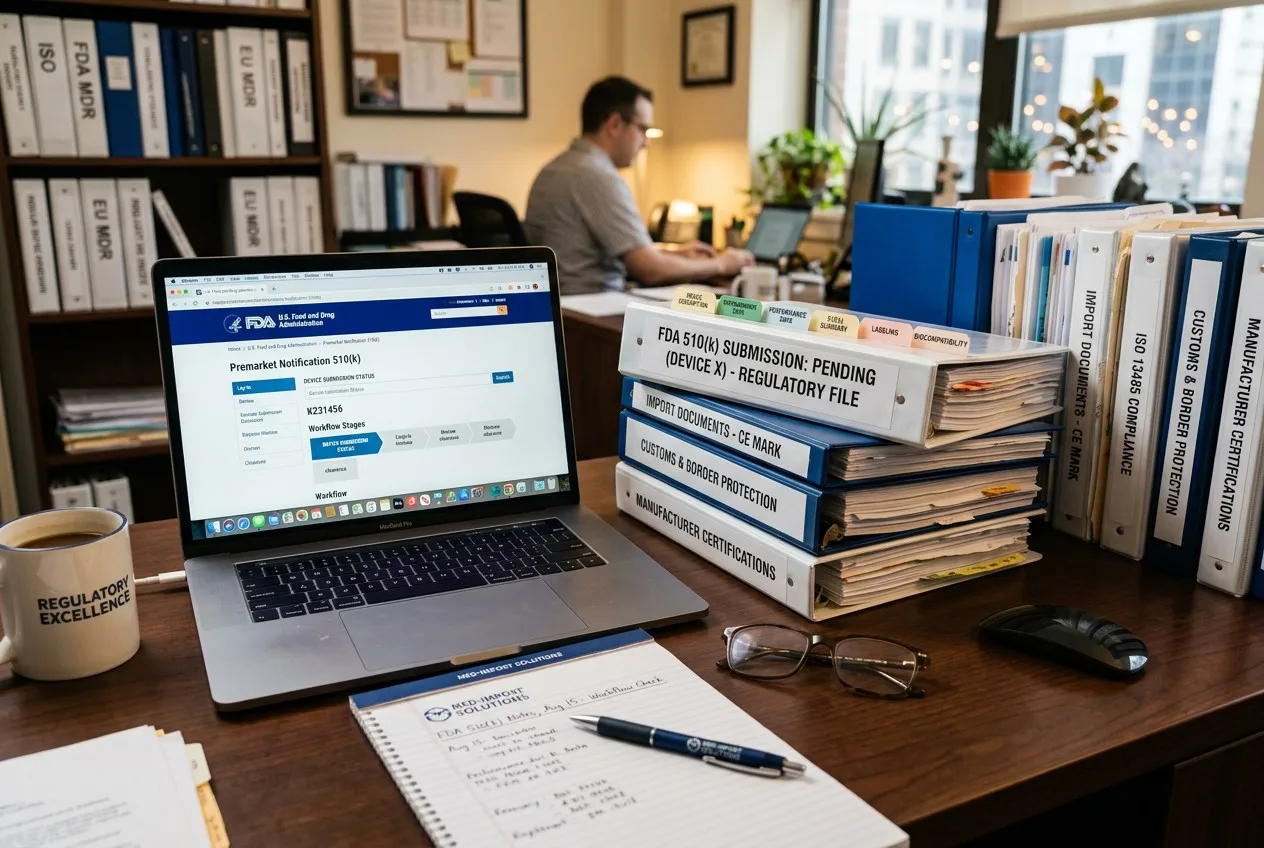
Are you feeling stuck in a maze of regulatory paperwork while your competitors are already selling in the US market? I know how frustrating it is to have great products but no “ticket” to the world’s largest market.
The FDA requirements for importing ophthalmic equipment to the US involve classifying your device, registering your establishment, and, for most clinical equipment, submitting a 510(k) premarket notification. You must demonstrate that your device is “substantially equivalent” to a legally marketed predicate device already sold in the US.
Navigating the FDA is a marathon, not a sprint. At Hongdee, we have spent years helping our distributors in the US and Latin America understand these hurdles. We hold ISO 13485 certification and have been working with CE and FDA standards for over a decade. Let me share what we have learned about getting your equipment across the border successfully.
Which FDA Classification Applies to Your Ophthalmic Device?
Do you find the FDA’s “Class I, II, or III” system confusing and worry about choosing the wrong one? I have seen many distributors waste months preparing for the wrong level of regulation.
Ophthalmic devices are classified into three categories based on risk. Most common equipment like slit lamps and fundus cameras are Class II, requiring a 510(k). Simple items like trial lens frames may be Class I and exempt from premarket notification, while high-risk implants or lasers are Class III.
Understanding the Risk-Based System
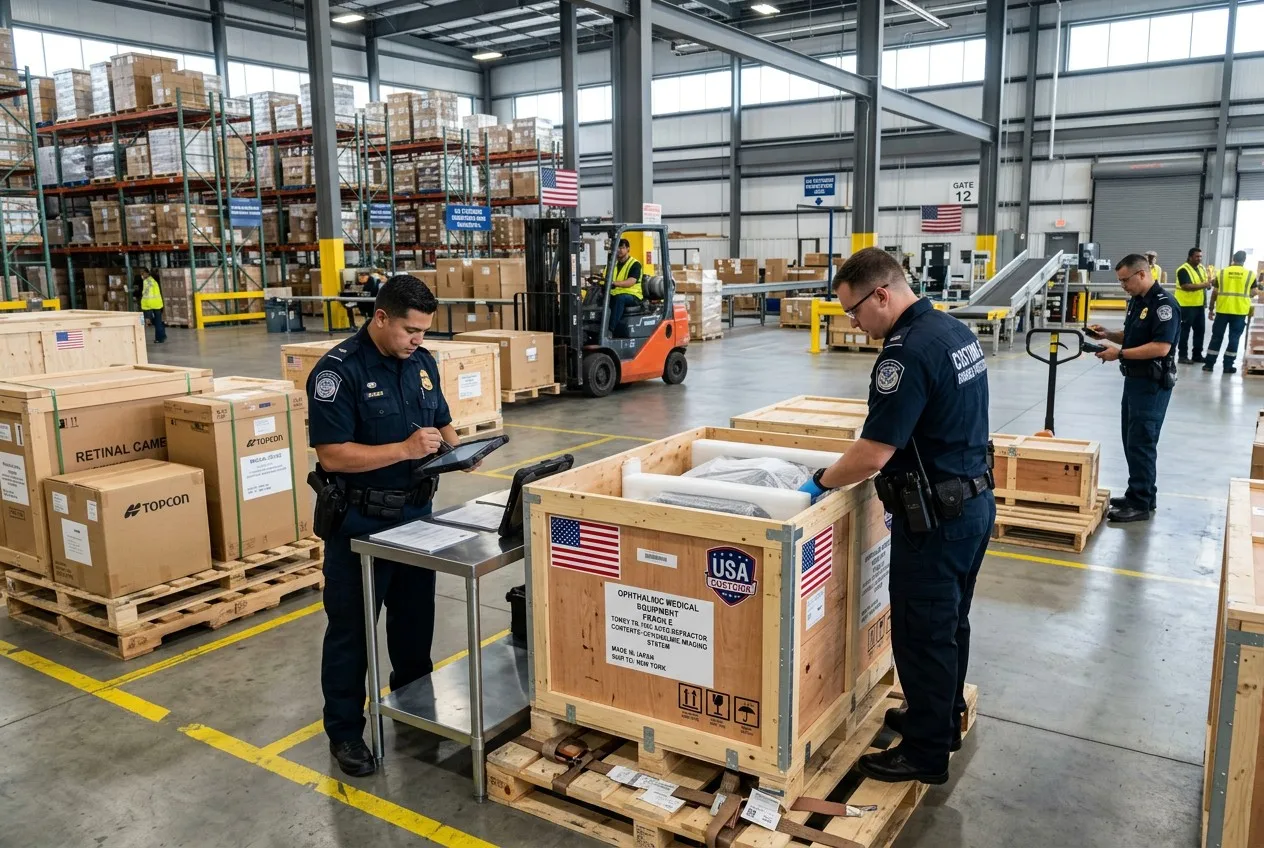
The FDA looks at how much harm a device could cause. If it touches the eye or provides critical diagnostic data, it is likely Class II. For example, our Hongdee slit lamps and tonometer are essential diagnostic tools. Because they touch or interact closely with the patient, the FDA wants to see data. I always tell my clients: “Know your class before you spend a cent on shipping.” If you misclassify, your shipment will be seized at the port.
The “510(k) Exempt” Exception
Some items are so low-risk that the FDA doesn’t need to review them before you sell. This is the “Exempt” category. Many non-powered hand tools or simple furniture like motorized tables might fall here. However, even if you are exempt, you still need to register your facility. I’ve seen distributors forget this “small” detail and get blocked. At Hongdee, we help you identify exactly where your product sits so you don’t overpay for compliance or under-prepare for inspections.
Common Ophthalmic Device Classifications
| Device Name | FDA Class | Submission Type |
|---|---|---|
| Manual Slit Lamp | Class II | 510(k) |
| Digital Fundus Camera | Class II | 510(k) |
| Chart Projector | Class I | Exempt |
| Applanation Tonometer | Class II | 510(k) |
| Trial Lens Set | Class I | Exempt |
What Documents Do I Need to File a 510(k) Submission?
Are you overwhelmed by the mountain of technical files required for a 510(k)? I know it feels like you’re writing a textbook just to sell a single piece of equipment.
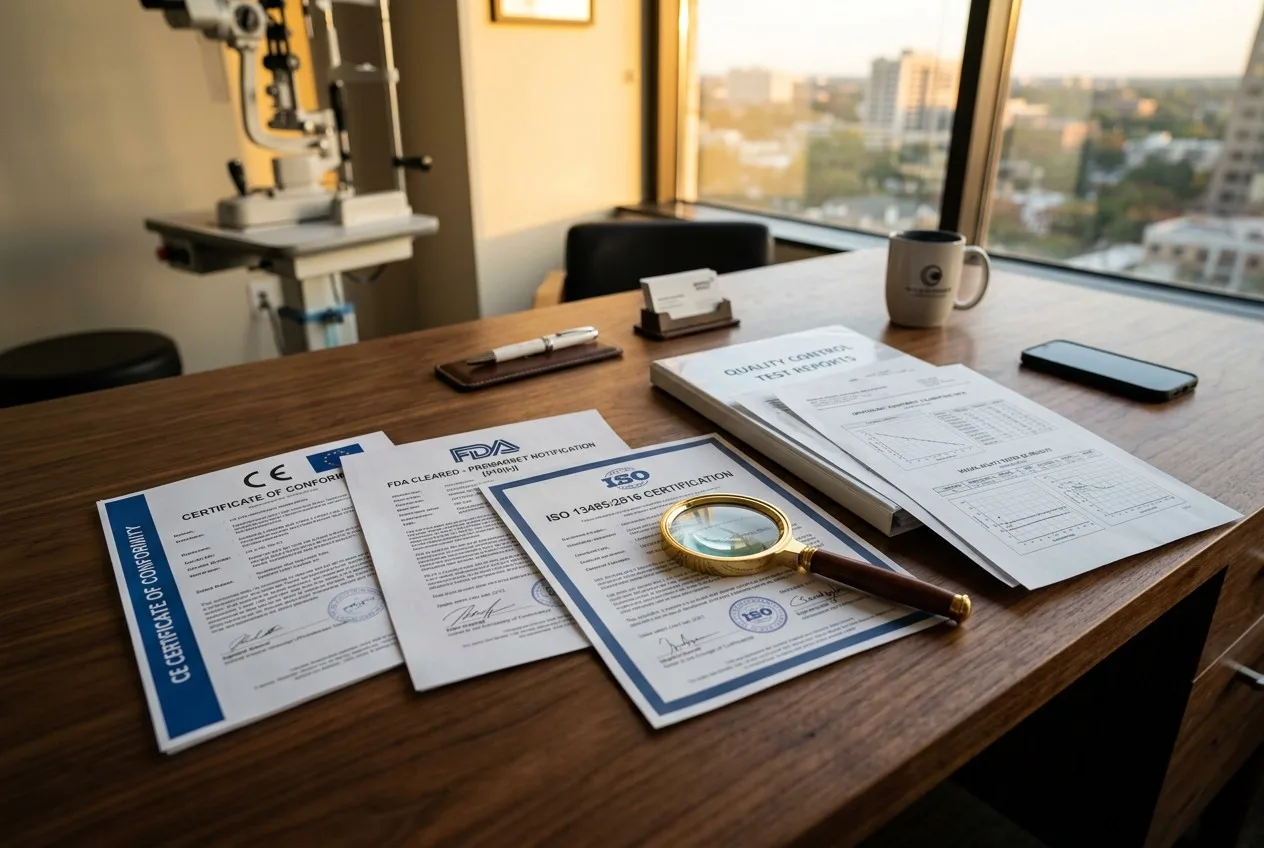
To file a 510(k), you need a detailed technical file including device description, labeling, sterilization data (if applicable), software validation, and performance testing. Most importantly, you must include a “Substantial Equivalence” section that compares your device to a “predicate” already on the US market.
The Technical File Deep Dive
This is where the real work happens. You need to prove that your equipment is safe. At Hongdee, we provide our partners with a “Technical Documentation Package.” This includes our circuit diagrams, material safety data, and factory testing results. If your manufacturer cannot provide these, you are in trouble. I’ve seen distributors try to “guess” the specs of a product they bought from a random trading company. The FDA will reject that in a heartbeat.
Software Validation: The 2026 Standard
In today’s digital era, software is a huge part of the FDA review. If your auto-refractometer or imaging system has software, you must show it won’t crash or give wrong data. This is why our 3 years as a Topcon OEM were so valuable. We learned how to document software bugs and fixes to meet international standards. We share these validation reports with our US partners to speed up their submissions.
Checklist for a Strong 510(k)
- [ ] Indications for Use: What exactly is the tool for?
- [ ] Performance Testing: Bench testing data showing accuracy.
- [ ] Electrical Safety: Evidence of passing IEC 60601-1.
- [ ] User Manuals: Must follow specific FDA labeling rules.
- [ ] Clinical Data: (Rare for Class II) Sometimes needed for new features.
How Long Does the FDA Registration Process Actually Take?
Do you feel like your business is on hold while waiting for a government agency to reply? I understand the stress of having capital tied up in inventory that you cannot legally sell.
The FDA registration process typically takes 6 to 9 months for a standard 510(k) review. This includes the initial administrative check, the substantive review, and potential “Requests for Additional Information” where the FDA asks for more data or clarification on your submission.
The “RTA” and Substantive Review Phases
The clock starts when you pay your user fee. First, the FDA does an “Acceptance Review” (RTA) which takes 15 days. If you missed a signature, they send it back. Then comes the “Substantive Review.” This is the long part. In my experience, you should expect at least one “AI” (Additional Information) request. This is normal! Don’t panic. It just means they are doing their job. We help our clients respond to these questions quickly by keeping our technical team on standby.
Factors That Can Delay or Speed Up Your Approval
I’ve seen some 510(k)s go through in 4 months and others take 2 years. The difference is usually the “Predicate” strategy. If you choose a predicate device that is almost identical to yours, the comparison is easy. If you try to claim your device is “unique,” the FDA will ask for more proof. We often recommend using a well-known brand like Topcon or Zeiss as a predicate because their data is public and trusted.
Expected Timelines by Stage
| Stage | Duration | Outcome |
|---|---|---|
| Preparation | 2-3 Months | Complete Technical File |
| RTA Review | 15 Days | “Accepted” or “Refused” |
| Substantive Review | 60-90 Days | “AI Request” or “Substantially Equivalent” |
| Final Decision | 30 Days | Clearance Letter (MIST) |
What Are the Hidden Costs of FDA Compliance?
Are you worried that the “entry fee” for the US market will wipe out all your potential profits? It’s a valid concern, as the costs go far beyond the initial application fee.
The hidden costs of FDA compliance include the annual Establishment Registration fee (approx. $9,000+ for 2026), 510(k) user fees, costs for third-party testing (UL/IEC), hiring a US Agent, and the ongoing expense of maintaining a Quality Management System (QMS) that meets 21 CFR 820 standards.
The Yearly “Tax” on Business
Many new distributors forget about the annual fee. Even if you don’t sell a single unit that year, you must pay the registration fee to keep your facility “active.” In 2026, these fees have risen again. You also need a “US Agent”—a person or company in the US who acts as your point of contact for the FDA. This is another monthly or yearly cost. At Hongdee, we help our partners find reliable agents who don’t overcharge.
Testing and Quality Audits
To get your 510(k), you often need fresh testing from a certified lab. This is to prove your equipment won’t cause electrical interference or catch fire. These tests (like IEC 60601) can cost $5,000 to $15,000 depending on the device. Then there is the QMS. The FDA can inspect your manufacturer at any time. Because Hongdee is ISO 13485 certified, we already meet about 90% of the FDA’s QMS requirements. This saves our distributors a massive amount of stress and money in audit preparation.
Estimated “Hidden” Budget
- FDA User Fee (Small Business): ~$5,000 – $6,000
- Annual Registration Fee: ~$9,200 (changes yearly)
- Electrical Safety Testing: $8,000 – $12,000
- US Agent Fees: $1,500 – $3,000/year
- Quality Consultant: $5,000 – $10,000 (optional but recommended)
How Can My Chinese Manufacturer Help Me Get FDA Approval Faster?
Do you feel like you’re fighting the FDA alone while your manufacturer just sits back and waits for orders? I believe a manufacturer should be a partner in your regulatory journey, not just a supplier.
A Chinese manufacturer can speed up your FDA approval by providing a complete “510(k)-ready” technical documentation package, sharing existing clinical data or performance testing from other markets, and offering “Predicate Reference” cases from their other international clients to strengthen your “Substantial Equivalence” argument.

Reusing Success from Other Markets
Here is a secret: a lot of the work we do for Thailand FDA or CE certification is reusable for the US FDA. We recently helped a distributor by adapting a technical file we built for a successful Thailand FDA registration. The standards for precision and safety are similar. I don’t want my clients to reinvent the wheel. If we have the data, we give it to you. This “Technical Support” is why many of our 300+ customers have stayed with us for over a decade.
Active Participation in the Review
When the FDA asks a technical question about the internal wiring of a slit lamp or the algorithm of an auto-refractometer, the distributor usually doesn’t know the answer. We do. We provide direct support to your regulatory consultant. We can even hop on a call to explain our manufacturing process. At Hongdee, we understand that our success is tied to your clearance. We don’t just sell you the machine; we help you get the legal right to sell it.
Ways Hongdee Supports Your FDA Goal
- Pre-Cleared Technical Files: Organized data for your 510(k).
- ISO 13485 Compliance: Proves our factory is ready for FDA inspection.
- Experience with Predicates: We know which big-brand models match our specs.
- Fast Technical Response: We answer FDA queries within 48 hours.
- Flexible Labeling: We customize labels and manuals to meet specific FDA wording.
Conclusion
Getting FDA clearance for ophthalmic equipment is a complex but rewarding process that opens the doors to the world’s most lucrative market. With the right manufacturer partner and a clear predicate strategy, you can navigate the 510(k) maze and start your US distribution journey with confidence.