



Buying the wrong slit lamp costs you more than money. It slows your daily exams, frustrates your team, and leaves you second-guessing every diagnosis for years.
To choose the right slit lamp for your eye clinic, evaluate five things: magnification steps, illumination brightness, slit width and length, filter set, and ergonomic design. Then match those specs to your patient volume, exam room space, and long-term service needs.
I have spent 15 years watching distributors and clinic owners make the same three mistakes. In this post, I want to walk you through what actually matters — and what does not — when a slit lamp lands on your quote sheet.
What Is a Slit Lamp and Why Does Every Eye Clinic Need One?
Most eye complaints start at the anterior segment. A slit lamp is how you look there — clearly, safely, and repeatably.
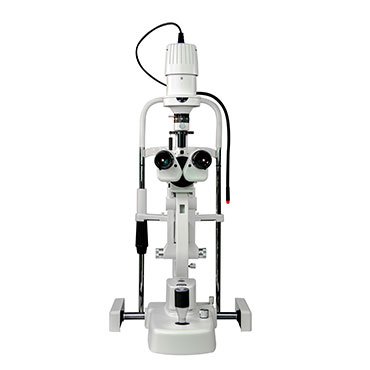
A slit lamp is a binocular microscope with a high-intensity slit-shaped light source, used to examine the front and back of the eye at magnifications from 6x to 40x. It is the single most-used diagnostic device in any eye clinic, from primary care optometry to hospital ophthalmology.
Why the slit lamp is non-negotiable
I have never visited a working eye clinic that did not have at least one slit lamp. It is the base of the exam lane. Without it, you cannot properly assess the cornea, iris, lens, anterior chamber, or with the right accessory lens, the retina.
Here is the breakdown of what a slit lamp lets you do:
| Structure examined | What you look for |
|---|---|
| Cornea | Abrasions, ulcers, dystrophies, foreign bodies |
| Anterior chamber | Cells, flare, depth (angle assessment) |
| Iris | Nodules, transillumination defects, synechiae |
| Lens | Cataract grading, subluxation, capsule integrity |
| Vitreous and retina | With a 90D or 78D lens, posterior pole and macula |
If you buy a cheap slit lamp with poor optics, every one of these observations gets harder. A pediatric patient will not sit still long enough for you to re-focus. A borderline cataract case will be graded inconsistently. Small errors compound into missed diagnoses.
So the question is not whether you need a slit lamp. It is which one, and how much you should spend.
What Are the 5 Key Slit Lamp Features I Should Evaluate?
Specs on a brochure look similar across brands. But the differences between them decide whether you enjoy or dread your workday.
The five features that matter most are: magnification (usually 5 or 6 steps from 6x to 40x), illumination brightness (LED preferred, halogen still common), slit width and length control (0.1 mm to 14 mm width, 1 mm to 14 mm length), filter set (cobalt blue, red-free, heat-absorbing, diffuser), and ergonomic design (joystick smoothness, chin rest travel, eyepiece diopter adjustment).
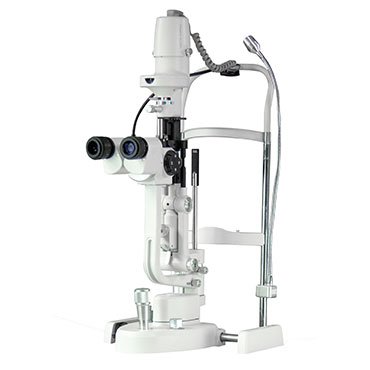
Digging into each of the five
1. Magnification steps. A 3-step drum (10x, 16x, 25x) works for basic exams. A 5- or 6-step turret (6x, 10x, 16x, 25x, 40x) gives you the range you need for detailed corneal work and vitreous inspection. If you plan to do specialty work like keratoconus screening or angle assessment, do not settle for less than 5 steps.
2. Illumination brightness. LED illumination has largely replaced halogen. LEDs run cooler, last 20,000-plus hours, and give a whiter, more color-accurate light. Halogen still shows up on budget units. It costs less upfront but you will change bulbs often and the color rendering suffers over time.
3. Slit width and length. For angle grading (Van Herick), you need a narrow slit down to 0.1 mm. For scanning larger corneal lesions, you need a wide slit up to 14 mm. Confirm both ends of the range on the spec sheet — do not assume.
4. Filter set. Cobalt blue is mandatory for fluorescein staining. Red-free helps you see vascular abnormalities. Heat-absorbing protects patient comfort during long exams. Diffuser softens the light for external photography. Any slit lamp missing cobalt blue is not fit for clinical use.
5. Ergonomic design. This one gets ignored in spec comparisons and then punishes you every day. A stiff joystick tires your hand. A short chin rest travel forces awkward patient posture. Bad eyepiece diopter adjustment gives you a headache by lunch. If possible, request a demo unit or a video walkthrough before you commit.
Tabletop vs. Handheld Slit Lamps: Which Type Matches My Patient Volume?
Not every exam happens in a fully equipped room. The form factor of your slit lamp should match how and where you actually see patients.
Tabletop slit lamps deliver the best optical quality and are the standard for high-volume clinics and hospitals. Handheld slit lamps are lighter, battery-powered, and ideal for home visits, pediatric wards, ICU rounds, mobile screening camps, and veterinary practice — anywhere the patient cannot come to the exam lane.

Matching form factor to workflow
Here is how I usually help distributors match their end-clients:
| Clinic type | Recommended form factor |
|---|---|
| High-volume optometry practice, 40+ patients per day | Tabletop, 5-step magnification, LED |
| Ophthalmology specialty clinic (glaucoma, cornea, retina) | Tabletop with imaging system, 6-step magnification |
| Rural or mobile screening program | Handheld, battery-powered, LED |
| Hospital bedside consult | Handheld, plus one tabletop in the exam room |
| Optical retail store doing basic health checks | Compact tabletop, 3- or 5-step magnification |
| Veterinary ophthalmology | Handheld, adjustable head strap, LED |
A common mistake I see is trying to force one form factor to cover every use case. A large hospital that only owns tabletop units cannot easily do ward rounds. A rural NGO that only owns handhelds struggles with detailed anterior segment work. Most practices need at least one of each once they grow past a certain size.
For distributors, this matters because you can bundle both types together in the same proposal and increase your order value without adding much delivery complexity. Both types ship in similar packaging and the training overhead is minimal.
New vs. Refurbished Slit Lamps: What Is the Real Cost Difference?
The upfront price gap between new and refurbished is real. So is the difference in long-term reliability.
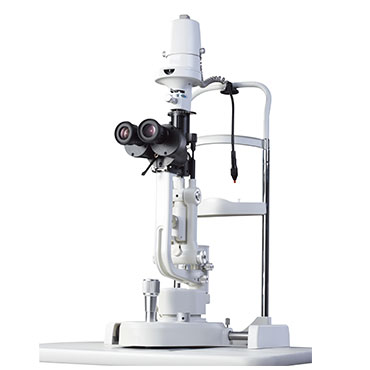
A refurbished slit lamp from a reputable source can save 40 to 60 percent on the initial purchase. But the long-term total cost of ownership often narrows that gap because refurbished units have shorter warranties, fewer available spare parts, and older optical coatings that degrade faster. For most new clinics, a new mid-tier slit lamp from a direct manufacturer beats a refurbished premium brand.
The full ownership math
The sticker price is only the start. Here is what a full 10-year ownership cost looks like in my experience:
| Cost category | New slit lamp (mid-tier direct-from-manufacturer) | Refurbished premium brand |
|---|---|---|
| Upfront price | Baseline | 40-60% lower |
| Warranty | 1-2 years full, extendable | 30-90 days typical |
| Spare bulbs and parts | Available for the full lifetime | Often discontinued or hard to find |
| Repair labor | Free during warranty, then modest | Higher hourly rate for older models |
| Software/imaging updates | Included and ongoing | None |
| Resale value at year 10 | Higher, as unit still supported | Near zero |
For distributors, refurbished stock can move quickly at price-sensitive markets. But the after-sales calls also multiply. I always advise partners to be transparent with their end-clients about what the refurbished label really means, and to stock a small spare-parts inventory for the models they resell.
If a customer asks about shipping — because shipping is one of the top three questions I hear — the answer depends on the form factor. Tabletop units usually ship by sea (2-3 weeks to Asia, 6-7 weeks to Americas and Europe) in shock-proof wooden crates. Handhelds can go by air (7-14 days). Either way, insist that the manufacturer provides shipping insurance and a shipment tracking number.
What After-Sales Support Should I Expect from a Slit Lamp Manufacturer?
Buying a slit lamp is not a transaction. It is the start of a 10-year relationship. Choose the manufacturer accordingly.
At minimum, expect a 12-month full warranty, free technical training (video or on-site), spare bulbs and fuses shipped with the unit, guaranteed spare parts for at least 7 years, and a named contact person for service escalation. Any supplier who cannot commit to these five in writing is not a serious long-term partner.
What to ask before you sign the PO
Compared to competitors who ship the unit and vanish, a genuine manufacturer gives you a written service commitment. Here is the checklist I share with new distributors:
- Warranty length and scope: Is it full warranty or parts-only? Does it cover shipping of replacement parts?
- Response time: How many hours until a technician answers your email or WhatsApp?
- Repair or replace policy: For a defective unit within 30 days of arrival, does the supplier replace it or only repair?
- Spare part shelf life: How many years will bulbs, joystick mechanisms, and prism blocks be stocked?
- Training resources: Are there installation videos, user manuals in your local language, and refresher training for new staff?
- Escalation path: If your normal contact is unreachable, is there a management-level backup?
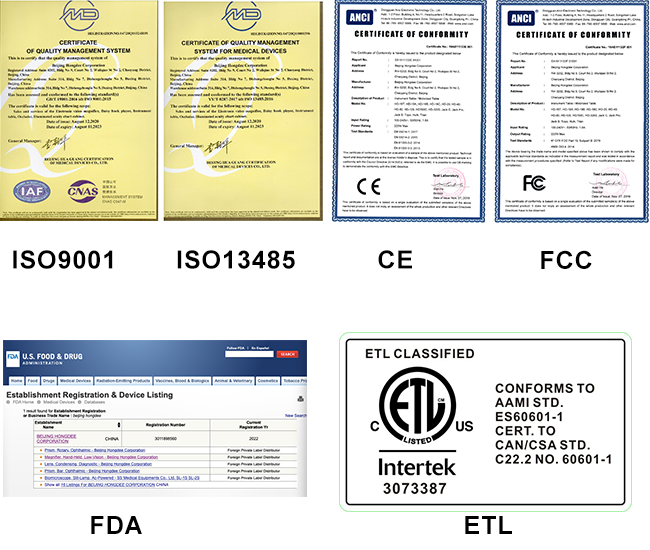
Distributors reselling into regulated markets should also request all product documentation upfront — CE certificates, FDA 510(k) if applicable, ISO 13485 quality certificates, and technical files needed for local registration. A manufacturer that hesitates on any of these is a manufacturer you cannot fully trust.
One more point on comparing suppliers. Chinese manufacturers, Japanese-German premium brands, and US-based dealers all have real trade-offs. Chinese direct manufacturers usually offer the best price and OEM flexibility. Japanese-German brands offer the strongest brand recognition and premium optics. US dealers add local service coverage but at a markup. There is no universally right answer — only the right answer for your market and your clients.
Conclusion
Choosing the right slit lamp comes down to matching the five key features to your patient volume, form factor to your workflow, and manufacturer to your long-term service needs. Get those three right and the daily exam feels effortless for years.