


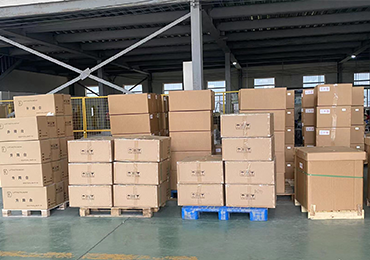
You found a good supplier, but the fear is real. A slit lamp that costs thousands arrives with a hidden misalignment. Nobody sees it at first. Weeks later, clinics complain. I will show you the shipping system we at Hongdee use so your first import does not end this way.
The short answer: you ship safely by agreeing clear Incoterms, demanding a proper packaging standard, choosing the right freight mode, preparing customs documents in advance, and inspecting within 48 hours of arrival. Each step protects a different part of your investment. Skip one, and the whole chain gets weaker.
So let me walk you through the five decisions that decide whether your shipment arrives perfect or arrives with a silent problem. I have packed and shipped ophthalmic equipment for 15+ years, and the biggest losses I have seen were never caused by rough handling alone. They were caused by gaps in planning.
Which Incoterms Protect a First-Time Importer Best?
You order from China and suddenly you hear terms like FOB, CIF, and EXW. They sound like alphabet soup. Pick wrong, and you own the risk before the goods even reach the ship. New importers get burned here more than anywhere else.
For a first import, choose FOB (Free On Board) with the supplier’s port as the handover point, and buy your own sea or air freight from there. You keep control of the carrier, the insurance, and the customs broker. That control is worth more than the small saving a CIF quote offers.
Here is why this matters in practice. Under FOB, the supplier is responsible until the goods are loaded onto the vessel at the named port. From that moment, the risk is yours, but so is the decision power. You choose the forwarder. You choose the insurance. You choose who clears customs at your end. That means one accountable partner for the whole journey on your side.
At Hongdee we have shipped to over 60 distributors across the USA, Thailand, Singapore, Italy, and Algeria, and we see the pattern clearly. Buyers who let the seller arrange everything often discover too late that the insurance was minimal, or that the freight quote did not include destination charges. A distributor in Australia once told me he saved on the freight quote and then paid triple in storage fees because the cargo sat at the port while he sorted out documentation.
What to check before you sign
- Confirm the named port matches your actual route.
- State in the contract that the seller must provide full export documents on time.
- Decide who pays for insurance and at what value — insuring at invoice value plus a margin is a sensible default.
The table below shows how the common Incoterms shift risk and cost:
| Incoterm | Seller’s responsibility ends | Who arranges main freight | Who insures | Best for |
|---|---|---|---|---|
| EXW | At seller’s factory | Buyer | Buyer | Experienced buyers with local agent |
| FOB | At named export port | Buyer | Buyer | First-time importers, most control |
| CIF | At destination port | Seller | Seller | Buyers who want one quote, less control |
| DDP | At your door | Seller | Seller | Highest price, least work for buyer |
The pattern is simple. The more the seller arranges, the less control you keep. For precision optics, I recommend FOB every time for a first order.
What Packaging Standard Should Precision Optics Require?
Precision optics do not break like glass jars. They shift. A collimation error of less than a millimetre changes what the clinician sees, and no bubble wrap fixes that. Standard cartons are simply not enough.
Demand export packaging that is moisture-proof, shock-proof, and water-proof — the same standard we at Hongdee use for every shipment. That means sealed inner bags with desiccant, foam-cut inserts that lock the instrument in place, a strong outer carton, and a wooden case for sea freight or large units.
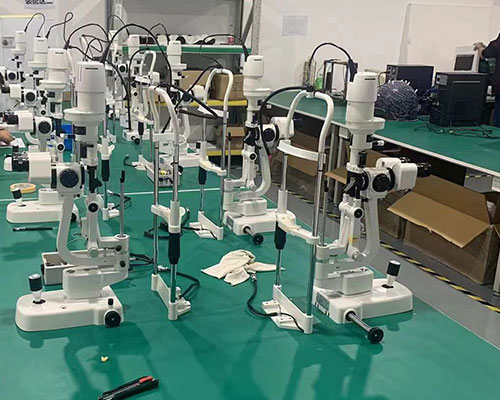
Let me explain what each layer actually does. The sealed inner bag with desiccant stops humidity from fogging internal optics during the voyage. The foam inserts are cut to the exact shape of the instrument, so it cannot slide or knock against the walls. The outer carton absorbs the first impact. The wooden case adds structural strength for the long, rough journey across oceans.
We learned this the hard way over 15+ years of manufacturing. Every unit we ship — slit lamps, fundus cameras, tonometers — follows the same rule: if the packaging cannot survive being dropped, kicked, and stacked, the instrument inside is at risk. Our standard export packing uses cartons and wooden cases that are moisture-proof, shock-proof, and water-proof, and it is part of why our customers reorder.
What the packing list must show
Ask your supplier to include these in the contract:
- Inner sealed bag with desiccant for every unit
- Foam-cut interior, not loose fill
- “Fragile” and “This side up” markings on every outer carton
- A wooden case for sea shipments and for units over a certain size
- Photos of the packed unit before the carton is sealed
One more thing: photograph the crate before it opens. That single habit has saved our customers thousands in insurance claims.
Air, Sea or Express: How Do You Decide per Order Size?
Express, air, or sea — the price difference is huge, and so is the risk profile. Choose express for a single trial unit and you pay like it is jewellery. Choose sea for a rush order and you wait for weeks. The right answer depends on order size and urgency.
Here is the rule of thumb we use at Hongdee: express for samples and urgent single units, air for medium orders and time-sensitive stock, sea for full container loads and routine replenishment. If you are ordering one machine to test, express makes sense. If you are filling a warehouse, sea freight wins on cost.
Let me give you the actual numbers we quote to customers, so you can budget with confidence. Express delivery takes 7-10 days. Air freight takes 7-14 days. Sea freight takes 2-3 weeks to Asia, and 6-7 weeks to America and Europe. A distributor in Italy restocking standard slit lamps uses sea freight because the price per unit drops dramatically. A clinic in Singapore ordering a single tonometer for a new branch pays for air because time matters more.
A simple decision table
| Order type | Recommended mode | Delivery time | When to choose it |
|---|---|---|---|
| One trial unit / sample | Express | 7-10 days | Testing the market or a new model |
| Medium order, urgent | Air | 7-14 days | Clinics waiting on a purchase order |
| Full container, routine | Sea | 2-3 weeks (Asia), 6-7 weeks (US/EU) | Filling stock, best unit economics |
| Heavy or large units | Sea in wooden case | Same as sea | Where air cost becomes prohibitive |
The general rule: never ship a single cheap item by air unless it is urgent — the freight can cost more than the item. And never ship a full container by express, because no express service handles pallets economically.
How Do You Handle Customs Clearance and Device Documentation?
The crate arrives, and then the paperwork starts. Missing certificates can hold your goods at the border for days, and demurrage charges climb every single day. This is where many first-time importers lose both time and money.
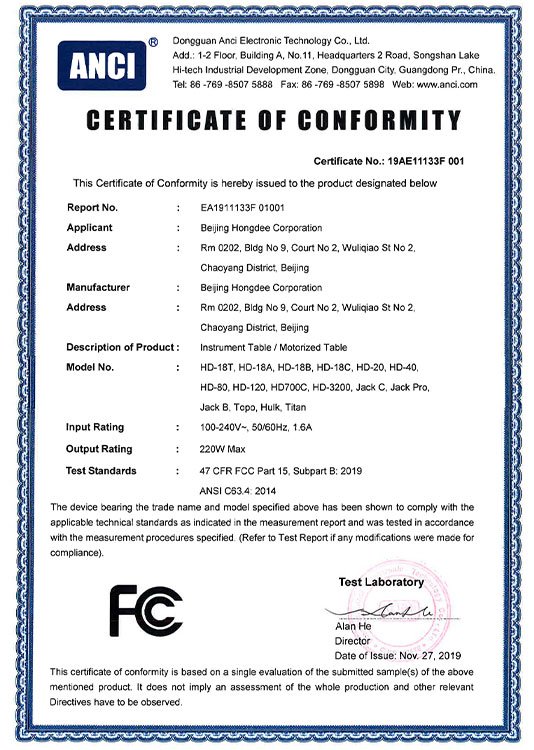
Prepare a documentation folder before the goods ship: commercial invoice, packing list, bill of lading or airway bill, certificate of origin, and the device certificates such as ISO 13485, CE, or FDA where your market requires them. Send the folder to your customs broker in advance, and clear the paperwork while the cargo is still in transit.
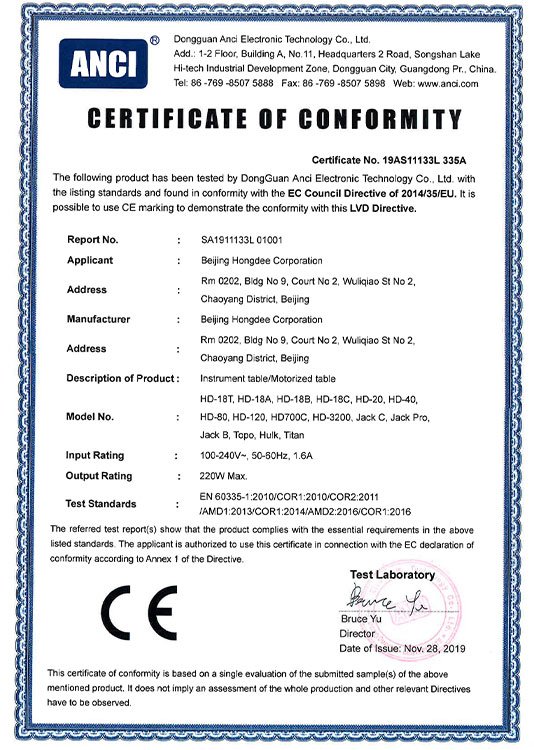
At Hongdee we hold ISO 13485, ISO 9001, CE, ETL, FDA, and SGS certification, and we send these documents with every shipment. But the certificate list your market needs depends on your country. A buyer in the Middle East may need different paperwork than a buyer in Southeast Asia. So ask your broker early, not when the ship docks.
The documents you need, and why
- Commercial invoice — the value customs uses to calculate duty.
- Packing list — weight and dimensions for freight and inspection.
- Bill of lading / airway bill — proof you own the goods in transit.
- Certificate of origin — sometimes lowers or removes duty.
- Device certificates — CE, FDA, ISO 13485, or local registration proof.
One practical tip: keep the declared value consistent between the invoice, the insurance, and the customs declaration. Discrepancies trigger inspections, and inspections cost days.
What Should You Inspect Within 48 Hours of Delivery?
Here is the trap I warned you about at the start. The unit looks fine. The box has no dents. You sign the delivery note. Then, three weeks later, users complain about poor images and blurry alignment. The damage was silent all along.
Within 48 hours of delivery, photograph the crate before opening, then run a simple arrival protocol: check optical alignment or collimation, test illumination brightness and evenness, run the mechanical travel of the stage and knobs, and record everything with photos. If something fails, report it immediately — our warranty and replacement policy only works when we know fast.
Let me give you the exact check we recommend our distributors run. First, photograph the crate from all sides before you cut the straps. Second, open it and photograph the inner packing exactly as it sits. Third, set the instrument up and run the checks below. This takes about thirty minutes, and it protects a claim that could otherwise take months.
The 48-hour arrival checklist
| Check | What to look for | Why it matters |
|---|---|---|
| Collimation / alignment | Single, centred beam pattern | Silent damage hides here |
| Illumination test | Even, bright field, no flicker | Reveals bulb or wiring damage |
| Mechanical travel | Smooth stage and knob movement | Detects shock damage |
| Crate photos | Taken before opening, all sides | Evidence for insurance claims |
If anything fails, photograph it, note the serial number, and contact the supplier within the 48-hour window. At Hongdee we back every unit with a 12-month warranty, free replacement within the warranty period, and a 10-day unconditional return window, so an honest report gets you a fast fix. A silent one gets you nothing.
Conclusion
Safe shipping comes down to five habits: choose FOB, demand sealed export packing, match freight mode to order size, prepare documents early, and inspect within 48 hours. Do these, and your first import from China arrives ready to sell, not ready to explain.